
The Ceasefire Trap
Tehran Believes Preserving its Leverage Requires More than Diplomacy

On June 3, Iranian drones struck Kuwait’s international airport, killing one person and wounding more than sixty, as part of a wider wave of attacks that also targeted U.S. bases in Kuwait and Bahrain. The strike followed a sequence that has become characteristic of the ceasefire period: U.S. forces disabled a Botswana-flagged oil tanker heading toward Iran’s Kharg Island with a Hellfire missile; Iran responded by targeting what it described as the command-and-control facility responsible for U.S. maritime operations; American strikes then hit Iranian military positions near Qeshm Island. Each exchange was framed by both sides as a response to the previous one, and each left the ceasefire nominally intact.
Asked about the Iranian strikes later that day, U.S. President Donald Trump offered a rather interesting formulation. “I’d say that part of the world,” he told reporters, “a ceasefire is when you’re shooting in a more moderate manner.” He then pivoted to expressing optimism that a deal with Iran could be signed “over the weekend.” Days earlier, U.S. and Iranian negotiators had reportedly agreed on the text of a 60-day memorandum of understanding to extend the ceasefire and open a path toward nuclear talks. But the document remained unsigned after Trump requested amendments to the text.
A few months ago, incidents of this scale – Iranian drone and missile strikes on U.S. bases and simultaneous U.S. strikes within Iranian territory – would have signaled an imminent major escalation. Today, they coexist with active mediation, continued diplomatic signaling, and public claims from both sides that a deal remains within reach. This is the new reality of the conflict. The ceasefire has altered the form of the confrontation without resolving its substance. And increasingly, in Tehran, this distinction is becoming the central strategic concern.
The argument gaining ground among Iranian officials, security elites, and pro-government analysts is that the ceasefire has become the arena in which the outcome of the war will be determined. The United States and Israel are using this period to reshape realities on the ground, weaken Iran’s leverage, and arrive at a negotiating table where Tehran’s position has already been quietly eroded. This perception is strengthening those within the Islamic Republic who argue that diplomatic restraint, under current conditions, carries its own strategic costs.
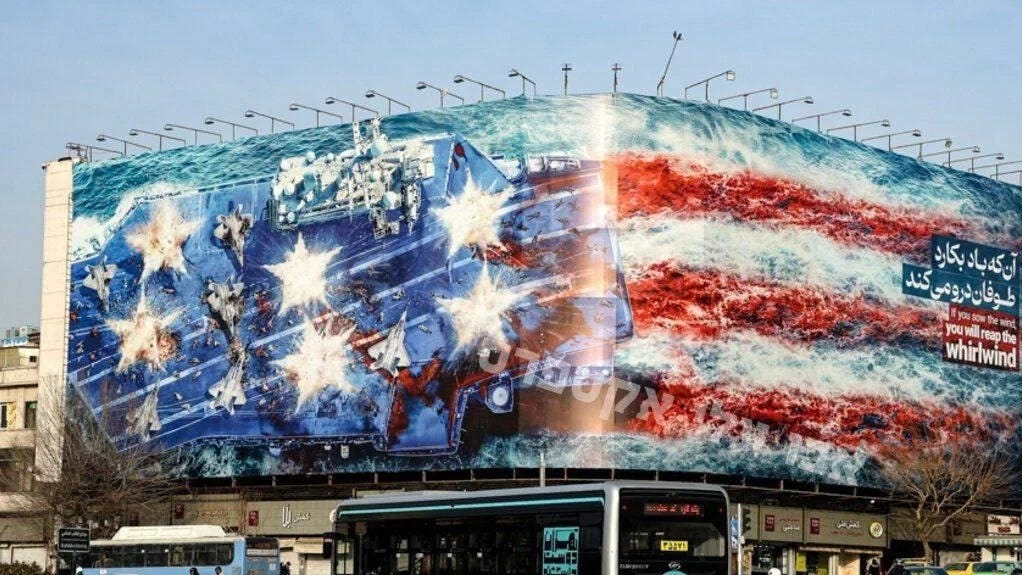
The Fight Over the Outcome of the War
The Islamic Republic does not currently believe the war is over. Nor does the dominant view in Tehran hold that another round of large-scale hostilities is imminent. What Iranian officials and strategic circles increasingly describe instead is a transitional phase whose character is genuinely contested – a period that looks like a ceasefire from the outside but functions, from Tehran’s perspective, as an extension of the same confrontation through different instruments.
The evidence sustaining this reading is concrete. The U.S. naval blockade, imposed after the failure of the Islamabad talks in April, remains in place. By Washington’s own estimate, it has cost Iran roughly five hundred million dollars per day. U.S. military strikes have continued throughout the nominal ceasefire period, with attacks on Iranian military positions near Bandar Abbas and Qeshm Island among the most recent. In the meantime, Israel has intensified its campaign against Hezbollah in southern Lebanon, with Israeli Defense Minister Israel Katz explicitly stating that the Israel Defense Forces retain “freedom of action” in Lebanon, including Beirut, regardless of diplomatic developments. Negotiations between Washington and Tehran have produced a draft text that neither side has signed.
In Tehran’s strategic reading, this combination points to a deliberate pattern. The delay in finalizing the memorandum of understanding is increasingly interpreted as purposive rather than procedural and as a U.S. attempt to use the passage of time as a strategic instrument. The concern is that each week of ceasefire, with American military and economic pressure continuing unabated and Iranian restraint producing no reciprocal concessions, represents a net erosion of the position Tehran believes it secured during the forty days of active fighting.
This framing has reshaped the internal debate. The question in Iranian discussions is no longer simply whether to continue diplomacy or prepare for war, but whether the current diplomatic track, as structured, is itself becoming a mechanism of strategic erosion. At the same time, the political atmosphere inside the country is unfavorable to a quick agreement because hardline factions view any visible adjustment as surrender, while the government seeks to avoid appearing weak without having secured sanctions relief. In these circumstances, the government finds itself caught between two simultaneous pressures. Engaging in diplomacy without tangible gains – no sanctions relief, no end to the blockade, no reciprocal restraint from Washington – makes the leadership appear to be negotiating from weakness. Yet the human and economic toll of the war makes it equally difficult to justify continued sacrifice without a credible account of what it can actually produce.
The result is a growing Iranian perception that the ceasefire phase requires active management rather than patient restraint, and that Tehran must shape the conditions surrounding the negotiations rather than simply wait for them to produce an acceptable outcome. The most direct expression of this logic is the status of the Strait of Hormuz.
Hormuz and the Fear of Strategic Erosion
For Iran, the Strait of Hormuz has always been more than a military instrument. Over the course of the war, it became the primary mechanism through which Tehran translated battlefield endurance into political leverage. The closure of a waterway through which roughly one-fifth of global oil and liquefied natural gas had previously flowed generated an economic shock that no other Iranian action could have produced at comparable cost. The ability to maintain that pressure, or credibly threaten to restore it, has been central to Iran’s negotiating position throughout the ceasefire period.
What is now generating concern in Tehran is a specific and relatively quiet development that points to the potential erosion of Hormuz’s strategic value without a corresponding political concession from Washington. Over the past several weeks, U.S. Central Command has been quietly guiding commercial vessels through the Strait, with roughly 70 ships transiting over a three-week period, often running dark to avoid Iranian detection. This may encourage shipping companies to rebuild confidence in southern routes. Oil prices, which briefly approached one hundred dollars per barrel in early June, have remained below levels that would generate the kind of global economic emergency on which Iran’s strategic calculus depends.
In Tehran, this trajectory is read as an attempt to arrive at the negotiating table with Hormuz already partially defused – or, in other words, to extract the leverage instrument from Iran’s hand before a deal is concluded rather than as part of one. The fear is less a dramatic defeat than a gradual normalization of a process in which the operational significance of the Strait is steadily reduced until the point at which Iran agrees to formally reopen it yields little diplomatic or economic return. Several Iranian analysts, as well some officials, have warned explicitly that accepting the blockade as a permanent reality would ultimately cost more than confronting it.
A second dimension of the erosion concern involves the normalization of U.S. military strikes on Iranian territory during the nominal ceasefire. The analogy increasingly circulating in Iranian strategic and media discussions is southern Lebanon before the current war, i.e., a pattern in which one side conducts periodic strikes, the other responds with limited force, neither formally ends the ceasefire, and over time a new operational reality is established in which the stronger party retains freedom of action while the other absorbs costs without altering the fundamental balance. The concern in Tehran is that American strikes on Qeshm Island and other Iranian coastal positions – framed by Washington as “self-defense strikes” within a continuing ceasefire – are establishing exactly this kind of normalized asymmetry.
The economic dimension adds urgency to this assessment. Iran’s Central Bank has reported inflation exceeding 80 percent. Oil export revenues have collapsed. Reconstruction costs are substantial and remain unaddressed. These pressures do not translate straightforwardly into a greater Iranian willingness to compromise. From the perspective of Iran’s security-oriented decision-makers, a settlement that opens Hormuz, constrains the nuclear program, and delivers limited or delayed sanctions relief would impose permanent strategic costs without resolving the economic emergency. Breaking the blockade by force and restoring the ability to sell oil to China on Iran’s own terms, without nuclear concessions, is increasingly discussed as a preferable alternative to a deal that locks in an unfavorable strategic balance.
Why the Hardliners Are Winning the Argument
On May 29, Mohammad Bagher Ghalibaf – Iran’s parliament speaker and chief negotiator – posted a three-point statement on social media that distilled the emerging consensus among Iran’s security-oriented elites with unusual directness. “We secure concessions not through dialogue, but with missiles,” he wrote. “We have zero trust in guarantees and words; behavior alone is the metric. No action will be taken before the other side acts. The winner of any agreement is the one who uses its aftermath to better prepare for war.” The statement was issued the day after U.S. and Iranian negotiators had reportedly reached near-final agreement on a 60-day memorandum of understanding. Ghalibaf was simultaneously one of the architects of the draft deal and one of its most public skeptics.
The statement was less an ideological declaration than an empirical argument. Its logic rested on a specific reading of how Washington had responded to Iranian military action throughout the conflict. In June 2025, Iran struck Al Udeid Air Base in Qatar with fourteen missiles following U.S. attacks on Iranian nuclear facilities. Trump’s response was to thank Tehran for the “early notice,” describe the attack as “very weak,” and invite Iran to “proceed to peace and harmony.” The April 2026 ceasefire was agreed to by Washington after Iran imposed the Hormuz closure, producing an economic shock in global energy markets. Continued Iranian strikes throughout the nominal ceasefire period generated no return to major U.S. bombardment. And the attacks on U.S. military bases in Kuwait and Bahrain earlier this week prompted from Trump a rhetorical redefinition of the ceasefire rather than a punitive response.
Across this sequence, a pattern emerges that the Ghalibaf statement formalizes: Iranian military action at or below a certain threshold – apparently defined by the presence or absence of significant American casualties – produces diplomatic accommodation or rhetorical reframing from Washington, rather than meaningful escalatory punishment. The U.S. House of Representatives’ passage of a war powers resolution on June 3, with four Republicans joining Democrats in a 215-208 vote to limit Trump’s authority to continue striking Iran, further reinforces this reading. In Tehran’s calculus, Trump’s political constraints on re-escalation are intensifying, his munitions stocks have been drawn down by 96 days of conflict, and his domestic political base is fracturing around a war he presented as a brief military excursion. The leverage balance, from this vantage point, is moving in Iran’s direction.
Lebanon sharpens this logic further. On June 4, Israel and the Lebanese government agreed to renew a ceasefire framework, but without Hezbollah’s endorsement and without Hezbollah at the table. Katz immediately made clear that Israeli operations in southern Lebanon would continue. The next round of comprehensive talks was scheduled for June 22 in Washington. From Tehran’s perspective, this arrangement is a template for exactly the kind of sequential disaggregation Iran has sought to prevent: a bilateral U.S.-Iran deal that eases pressure on Iran while leaving Hezbollah exposed, followed by sustained Israeli pressure on a Hezbollah that has been diplomatically isolated from the settlement architecture.
Foreign Minister Abbas Araghchi’s formulation that “the ceasefire between Iran and the U.S. is unequivocally a ceasefire on all fronts; its violation on one front is a violation on all fronts” is Tehran’s structural answer to this risk. But the argument also carries a domestic dimension that makes it difficult to abandon. The internal case being made to both supporters and critics of the Islamic Republic is that Iran paid an enormous price during the war – the Supreme Leader was killed, cities were struck, the economy was damaged – and emerged as a dominant regional power. That claim loses its political coherence the moment Hezbollah is systematically degraded under a ceasefire that Iran accepted and that its most important regional ally did not endorse.
The convergence of these pressures – the erosion of Hormuz’s leverage, the economic costs of the blockade, Trump’s demonstrated pattern of absorbing Iranian strikes without re-escalating, and the trajectory of the Lebanon front – is generating a hardening of opinion within Tehran’s security-oriented circles that is more than rhetorical. Mojtaba Khamenei’s June 4 message to the public, in which he warned against “doubt, despair, fear, mistrust, and division” sown by the enemy, was directed simultaneously at domestic audiences absorbing real economic pain and at hardline constituencies that need wartime sacrifice to carry strategic meaning. In the same vein, his declaration of enemy “defeat” on the battlefield was primarily an exercise in managing the domestic political space.
As such, the central debate in Tehran is no longer whether diplomacy should continue, but whether diplomacy alone can preserve Iran’s position. As economic pressure mounts, Israel continues its campaign against Hezbollah, and Washington works to reduce the strategic significance of Hormuz before any deal is concluded, more voices within the Islamic Republic are arriving at the conclusion that leverage must be actively defended before it can be usefully negotiated.
The result is a paradoxical situation: both Iran and the United States continue to pursue a diplomatic agreement, yet both are increasingly behaving as if the ceasefire itself has become another arena of strategic competition. Whether that competition ultimately leads to a settlement or another round of war may depend less on the negotiations than on which side succeeds in shaping the realities that surround them.
Great piece, dear Hamidreza.
This is a great piece, the only thing I would add is that it appears as though Trump is further constrained from re-escalation by the Gulf states, whose appetite for any continued conflict is surely going to play a role in where this goes.