
How Mojtaba Khamenei Became the Supreme Leader
And What It Means for Iran’s Domestic and Foreign Policy

One week after the Islamic Republic’s long-time Supreme Leader, Ayatollah Ali Khamenei, was killed in U.S. and Israeli strikes on his office, his son Mojtaba was selected to succeed him. For years, the question of succession after Ali Khamenei had remained deliberately ambiguous. Various names circulated in elite and expert discussions, but none commanded the same combination of clerical authority, institutional influence, and ideological stature that the old Ayatollah had accumulated over decades. The system therefore left the issue unresolved, preserving flexibility while avoiding open competition.
The war changed that calculation. Faced with simultaneous external pressure, domestic fragility, and the sudden loss of the figure who had long served as the regime’s ultimate arbiter, Iran’s political and security elites had to move quickly to close ranks. In that sense, the choice of Mojtaba Khamenei was about something more than succession. It was primarily about stabilizing the system at a moment when uncertainty posed a strategic risk.
Mojtaba’s elevation thus reflects a broader logic that has long shaped the Islamic Republic in moments of crisis: when confronted with existential pressure, the regime tends to favor continuity over experimentation. By choosing the son of the late leader, who is deeply embedded in the system’s security and bureaucratic networks, the elite signaled that preserving institutional cohesion and ideological continuity would take precedence over any attempt to redefine the structure of power.
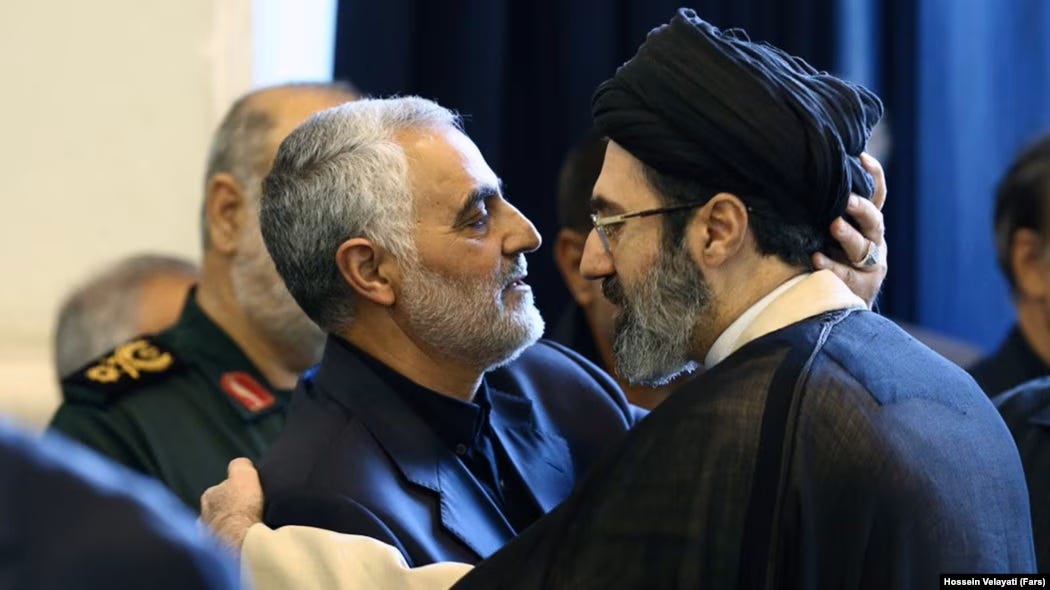
War and the Narrowing of Choice
Under normal circumstances, the question of succession in the Islamic Republic would likely have unfolded over a longer period and through a more complex process of elite bargaining. For years, different figures had been mentioned as potential successors to Ali Khamenei – ranging from senior clerics to political insiders – but none clearly dominated the field. The absence of a universally accepted candidate meant that the system retained some room for maneuver. In a peacetime setting, this could have allowed the regime’s power centers to negotiate a compromise, test different options, or even consider institutional adjustments, including the possibility of extending the role of an interim leadership council.
The outbreak of war fundamentally altered this landscape. Under conditions of intense external pressure and domestic fragility, the regime’s tolerance for uncertainty narrowed sharply. The Islamic Republic was already confronting a profound crisis of legitimacy at home. Only weeks earlier, the country had witnessed the largest wave of protests in the history of the Islamic Republic, followed by one of the most severe crackdowns in recent decades. Thousands were killed as the state moved to suppress the unrest. The scale of the protests and the violence of the response left the regime’s social legitimacy at its lowest since 1979. At the same time, Iran found itself engaged in a direct confrontation with the world’s most powerful military.
In such an environment, prolonged uncertainty at the top of the system carried significant risks. The longer the succession question remained unresolved, the greater the possibility of elite fragmentation, policy incoherence, and strategic miscalculation. Wartime conditions thus magnified the vulnerabilities the regime was already experiencing and deepened its sense of insecurity. The system required coordinated messaging, clear chains of command, and a single authority capable of arbitrating disputes within the political and security establishment.
A recent controversy involving President Masoud Pezeshkian illustrated how quickly the absence of such authority could create problems. Statements by Pezeshkian – who at the time was also a member of the interim leadership trio – apologizing for Iranian attacks on neighboring countries and suggesting they might stop triggered immediate controversy inside the system. Senior military commanders and other members of the political elite quickly moved to clarify the official position, emphasizing that attacks would continue as long as U.S. forces remained present in the region. The episode highlighted the risks of uncoordinated messaging during wartime and reinforced concerns within the elite about the dangers of a leadership vacuum.
Meanwhile, the Assembly of Experts – the body responsible for selecting the new Supreme Leader – was grappling with a broader strategic dilemma. Beyond identifying a successor, a key question was whether the Islamic Republic should preserve its existing institutional architecture or move toward some form of structural transformation. Over the years, Iranian analysts had outlined several possible scenarios for the post-Khamenei period: the emergence of a collective leadership council, the appointment of a largely symbolic figurehead while the security establishment governed behind the scenes, or even a gradual transition toward a more overtly military-dominated system.
Each of these possibilities, however, would have required time, negotiation, and potentially constitutional revision. None was easily compatible with the urgency imposed by war. Institutional experimentation in the midst of a national-security crisis risked deepening elite divisions and undermining the coherence of the state apparatus.
In the end, the regime opted for the safest path available, namely preserving the institution of the Supreme Leadership and the doctrine of velayat-e faqih that underpins it. Once that decision was made, the range of viable candidates narrowed considerably. The system needed a figure who could assume authority quickly, reassure the bureaucratic and security elite, and embody continuity at a moment of acute pressure.
Mojtaba Khamenei’s candidacy benefited directly from these conditions. For years, his name had circulated in discussions about succession, but his prospects were often viewed as uncertain, not least because dynastic succession sits uneasily with the ideological and religious foundations of the Islamic Republic – at least as Ayatollah Ruhollah Khomeini had originally envisioned it. Under wartime conditions, however, the calculus shifted. Mojtaba’s deep familiarity with the networks surrounding the office of the Supreme Leader, as well as his longstanding ties to key elements within the security establishment, made him a figure capable of minimizing uncertainty at the top of the system.
In this sense, contrary to what some observers argue, Mojtaba Khamenei’s rise was probably not – or at least not primarily – the product of a long-prepared dynastic transition. Instead, it was the result of a wartime narrowing of political choice. Faced with mounting internal and external pressures, Iran’s ruling elite concluded that preserving institutional continuity – and rapidly restoring a clear center of authority – outweighed the risks associated with elevating a controversial successor.
The Security Elite and the Logic of Absolute Continuity
If war narrowed the range of institutional options, the balance of power within the Islamic Republic ultimately shaped the outcome. In a sense, the question of succession was never seen as only about clerical qualifications or ideological symbolism. It was also very much about which faction of the state would define the post-Khamenei order.
Within the interim leadership structure, Pezeshkian was widely regarded as the weakest figure. Institutionally associated with the reformist camp, his position nonetheless reflected a longer-standing strategy pursued by moderates and reformists within the system: securing the presidency in order to gain a seat in any interim leadership arrangement that might emerge after the death of Ali Khamenei. The expectation was that such a position could provide leverage in shaping the succession process. In this context, figures such as former president Hassan Rouhani, Hassan Khomeini – the grandson of Ayatollah Ruhollah Khomeini – or other clerics with relatively moderate reputations were often viewed as preferable alternatives. Their selection would have preserved the institutional structure of the Islamic Republic while potentially softening its political orientation.
Other centers of power within the state approached the question from a very different perspective. For actors embedded in the judiciary, the security establishment, and particularly the Islamic Revolutionary Guard Corps (IRGC), the priority was safeguarding the system’s existing configuration of power. Figures such as Chief Justice Gholam-Hossein Mohseni-Eje’i and acting IRGC chief commander Ahmad Vahidi were closely aligned with this view. So too was Mohammad Bagher Ghalibaf, the speaker of parliament and a former Guards commander, who had long been associated with networks supportive of Mojtaba Khamenei.
These alignments were less about ideological affiliation than about institutional interests. Over the past two decades, the security establishment – above all the IRGC – has become the most powerful pillar of the Islamic Republic. Its influence extends across the military sphere, the intelligence apparatus, and large segments of the economy. From the perspective of these actors, the succession question was fundamentally about preserving a political environment in which their authority and networks would remain intact.
Mojtaba Khamenei offered a solution that few other candidates could match. Although he lacked the formal clerical stature of some senior religious figures, he possessed a different set of advantages. For years he had operated close to the center of power, maintaining ties with key elements of the security establishment and gaining deep familiarity with the extensive bureaucratic apparatus surrounding his father’s office. That apparatus – built over decades by Ali Khamenei – functions as one of the central coordinating nodes of the Iranian state. A successor already embedded in its networks would minimize disruption at a sensitive moment.
Equally important, Mojtaba represented continuity not only at the institutional level but also in terms of elite composition. His elevation reassured those within the system’s security core that the basic distribution of power would remain unchanged. By contrast, alternative candidates – particularly those associated with more pragmatic or reformist circles – carried the possibility, however limited, of reshuffling the balance among competing factions of the state.
The broader strategic environment further reinforced this preference for continuity. Iran’s ruling elite was confronting an unprecedented combination of pressures: a major external conflict, deep domestic discontent, and growing uncertainty about the durability of the regime’s social base. Under such conditions, experimentation at the top of the system appeared risky. Institutional change – even if limited – could easily trigger new rivalries or weaken the cohesion of the security apparatus on which the regime increasingly depends.
The support of the Islamic Republic’s ideological core also weighed heavily in this calculation. Although the regime’s overall popularity has eroded significantly, it continues to rely on a committed base of supporters who view the system not primarily as a provider of economic and social benefits but as a project grounded in religious and revolutionary principles. Any move toward overt institutional transformation, such as abandoning the doctrine of velayat-e faqih or replacing the Supreme Leader with a collective authority, would risk alienating this constituency.
In that context, Mojtaba Khamenei’s candidacy offered a powerful symbolic advantage. As the son of the late leader and a member of a family deeply associated with the Islamic Republic’s ideological narrative, he could serve as a bridge between the regime’s security elite and its loyalist base. His selection reassured the former that their institutional position would remain protected while signaling to the latter that the revolutionary project would continue uninterrupted.
For these reasons, Mojtaba’s rise reflected more than the outcome of elite maneuvering. It embodied what might be called the logic of absolute continuity: the preservation not only of the Islamic Republic’s institutional framework but also of the coalition of actors that has sustained it for decades. In the midst of war and internal crisis, that logic ultimately prevailed over alternatives that might have promised adjustment but carried the risk of destabilizing the system’s core.
Continuity at Home, Coherence Abroad
Mojtaba Khamenei’s elevation is significant primarily because of the kind of continuity it represents. His appointment preserves both the institutional architecture of the Islamic Republic and the configuration of power that has come to dominate it over the past two decades. In that sense, the transition signals not only the survival of the system but also the consolidation of its increasingly securitized character.
Domestically, Mojtaba was arguably the only figure capable of representing such complete continuity. Alternative candidates such as Rouhani or Khomeini could have preserved the structure of the Islamic Republic while introducing a somewhat different political tone and longer-term orientation. Mojtaba’s selection, by contrast, suggests that both the structure and the governing logic of the system will remain largely unchanged. Given the regime’s current circumstances – war, sanctions, and the aftermath of brutal internal repression – the prospects for meaningful reform appear limited. Economic restructuring remains constrained by sanctions and isolation, while significant political liberalization would risk further weakening a regime that already faces deep social discontent.
Under these conditions, the leadership’s immediate priority is likely to remain consolidation rather than reform. Mojtaba’s close ties to the security establishment suggest that governance will continue to rely heavily on the instruments of control that have come to define the Islamic Republic in recent years. At the same time, the leadership may seek to reinforce internal cohesion through selective elite restructuring. It remains unclear whether Mojtaba will continue relying on the older generation of officials who worked closely with his father or gradually promote a younger cadre within the security apparatus. Within the IRGC, younger commanders have increasingly voiced criticism of the so-called old guard, often combining a more hardline loyalty to the system with a somewhat more nationalist outlook. Such tensions could translate into changes at the upper levels of the military and security hierarchy as Mojtaba consolidates authority.
Beyond Iran’s borders, the logic of continuity carries additional significance. The Islamic Republic’s regional strategy relies heavily on a network of allied actors within the Axis of Resistance. For these groups, the Iranian Supreme Leader is not just a political figure but also a central ideological reference point. The Khamenei name carries considerable symbolic weight across this network, and Mojtaba’s status as the son of a leader widely portrayed as a “martyr” strengthens that symbolic capital. Even though he does not possess the same level of religious authority as his father, his identity and lineage make him uniquely capable of preserving a degree of ideological coherence among these actors.
This continuity also sends an important signal to Iran’s external partners. Russia and China moved quickly to acknowledge Mojtaba’s appointment, framing it as compliant with Iran’s constitutional arrangements. For Tehran, maintaining the confidence of these powers is particularly important at a moment of confrontation with the West. Both Moscow and Beijing play critical roles in providing diplomatic cover – especially in international institutions such as the United Nations Security Council – and in sustaining Iran’s economic and strategic partnerships. By selecting a successor closely associated with the Islamic Republic’s existing strategic orientation, the Iranian leadership reassured these partners that Tehran’s broader geopolitical alignment would remain stable.
There is also a certain irony in the outcome. The external pressure applied by the United States and Israel may have helped produce the very scenario they would have preferred to avoid. War compressed the regime’s decision-making process and elevated the value of continuity over transformation. Moreover, President Donald Trump’s public statement rejecting Mojtaba as an acceptable successor inadvertently strengthened the internal argument in his favor. Within the ideological logic of the Islamic Republic, the candidate most openly opposed by external adversaries can easily be framed as the most suitable guardian of the revolutionary project.
Power Preserved – for Now
Mojtaba Khamenei’s ascent underscores a recurring pattern in the Islamic Republic’s political evolution: crises tend to consolidate the system rather than transform it. Moments that might otherwise open space for institutional reconsideration instead push the regime’s elite toward greater cohesion and reliance on the structures that have historically sustained their rule. In this case, the combination of external confrontation, domestic unrest, and elite uncertainty did not produce a reconfiguration of power. Instead, it reinforced the centrality of the very institutions and networks that have long defined the system.
This outcome also highlights the adaptive logic of the Islamic Republic. Although its ideological framework often appears rigid, the regime has repeatedly demonstrated a capacity for pragmatic decision-making when survival is at stake. By selecting a figure embedded in the state’s security and bureaucratic core, the leadership effectively prioritized governability over doctrinal consistency and stability over innovation.
Whether this strategy will succeed in the long term remains uncertain. Absolute continuity may stabilize the system in the short run, but it also postpones unresolved structural tensions within Iranian politics and society. For now, however, the message of the transition is clear: confronted with one of the most consequential crises in its history, the Islamic Republic chose not to redefine itself but to preserve the order it already knows.
Salām va dorud Hamidreza,
Thank you for surveying these current and potential dimensions concisely here.
Two thoughts on irony.
1)
You mention "There is also a certain irony in the outcome. The external pressure applied by the United States and Israel may have helped produce the very scenario they would have preferred to avoid."
Strange isn't it? This is ironic in the sense that the result is the opposite of what was intended. But it's also what should have been expected, and what has been demonstrated at both small and medium scales over the past two years
for the strategic education of America and Israel, in the attempt to "eliminate" Hamas and Hizb'allah. I.e. it doesn't work, and their resistance convictions are strengthened.
Perhaps we could say the strategic irony is lost on America and Israel. But since Iran has been America's great Satan for forty years, and is the closest thing Israel has to an ultimate strategic nemesis, it would seem there is no higher to go, in the stakes of unrecognised irony and unlearned lessons.
This is another way of saying that the only subsequent step America and Israel can take is to do the same thing again - i.e. assassinate the new Supreme Leader.
Is this strategic irony? Or perhaps strategic blindness? Or perhaps just not strategic at all?
2)
More complicated, but just as ambiguous in its implications for the attackers, is what you mention about the Iranian backtracking on pledging no more attacks on neighbouring countries. Certainly it indicates less than perfect coherence in the interim leadership period. and
Pezeshkian's prospects are in general an open question.
But given the subsequent appointment of the new Supreme Leader, and the missiles that are continuing to fly, it would seem that not only has there been continuity from father to son due to the immediate pressures of wartime, but also that the regime can cope with considerable ambiguity (even incoherence) in public statements made from the highest level of government, and yet continue to act coherently in obdurate retaliation against its attackers.
Is this ironic? Maybe it's just further substantiation of the fact that this kind of attack involves a very high degree of confidence in success, despite there being quite a lot of evidence that the Iranian regime is neither weak nor subject to disintegration under pressure.
Something else occurred to me when reading your essay, that is probably too complex to be called irony - or on the other hand might indicate something simple yet formidable. You mention:
"Although the regime’s overall popularity has eroded significantly, it continues to rely on a committed base of supporters who view the system not primarily as a provider of economic and social benefits but as a project grounded in religious and revolutionary principles."
Indeed - but this is almost like saying that there just might be some political legitimacy in the Islamic Republic - not only embodied in a theo-military elite, but perhaps also in some of the population.
To think that this may be even slightly the case is bad news for an American president and an Israeli prime minister entertaining thoughts that, once bombed, the Iranian people will rise and push the Supreme Leader and IRGC aside.
Perhaps it also means that, thirty years since Olivier Roy's "The Failure of Political Islam," the only state in which an Islamist revolution has been successful has still not reached the point of internal collapse or susceptibility to external demolition.
I'm not sure if that is ironic, given Roy's certainty that Islamism is structurally unsuited to government.
Perhaps rather than ironic, it's just yet another indicator that, in international politics, reality turns out to be more complex than either the strategic expectations of politicians, or the analytical certainties of scholars.
It was good to read your essay alongside Ali Mamouri's on the succession:
https://menainsight.substack.com/p/what-do-we-know-about-mojtaba-khamenei?r=1l9yp4&utm_campaign=post&utm_medium=web
Kheili mamnoon, va shab bekheir.
Benedict
Hello Hamidreza, could you disclose to your readership whose payroll you are on and what you gain from these long articles. Also, who is feeding you all this information, i.e. your source(s)?