
The Man Who Would Be King
Ali Shamkhani and Iran’s Security-Managed Transition

In discussions of Iran’s domestic politics, some observers – half jokingly, half seriously – refer to a “law of conservation of elites”: within this isolated system, new political elites seldom rise to the top, nor do established figures fully disappear; rather, they are transferred from one position to another. This principle has not always held, particularly with regard to segments of the “reformist” faction that have been pushed out of the system over the past two decades. Nevertheless, at least one individual stands as a clear embodiment of this dynamic: Ali Shamkhani.
In early February, it was announced that the former senior IRGC commander – who has served as defense minister and as secretary of the Supreme National Security Council (SNSC) – had been appointed secretary of the newly established Defense Council. The body was formed after the 12-day war with Israel to formulate and coordinate military-defense policy. Although its membership was publicly known, no information had been released regarding its secretary. It later emerged that Shamkhani’s appointment, first reported by the Shamkhani-affiliated Nour News, dated back at least a month and had not been intended for public disclosure.
Both the revelation of the news and its timing – just before a new round of diplomatic talks between Iran and the United States and amid rising concern over renewed military confrontation – lent the development particular political significance. This was reinforced by Shamkhani’s renewed public presence since late 2025, during which he has commented on both military and diplomatic issues. In late December, he hinted at the possible introduction of a preemptive element into Iran’s military strategy, warning that Tehran would treat credible signs of threat as part of the threat itself and act accordingly. This position was echoed days later in an official Defense Council statement.
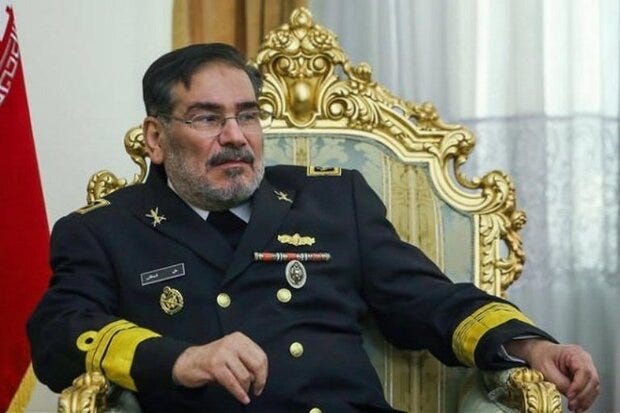
At the same time, Shamkhani intervened in debates over negotiations, outlining the parameters of a desirable agreement: talks, he argued, should remain strictly confined to the nuclear file, and even there Iran would not agree to transfer highly enriched uranium abroad. Appearing in military uniform for the first time in years, he also emphasized Iran’s readiness for war should diplomacy fail. The sequence is therefore difficult to interpret as coincidental, raising the question of what Shamkhani seeks through his recent political and media maneuvering.
What Does Shamkhani Represent?
Shamkhani’s recent positioning is best understood within the institutional architecture he now occupies. The Defense Council, though a relatively new body that may appear ad hoc at first glance, is far from symbolic. Its creation followed the severe blows Israel inflicted on Iran’s command structure and military infrastructure during the June 2025 war and reflected a growing perception within the Islamic Republic’s leadership that survival under sustained military pressure requires tighter, routinized coordination. In essence, the council is designed as a platform linking operational military considerations with high-level political decision-making. By publicizing his role at its head, Shamkhani appears intent on underscoring his function as the connector between these two spheres at a moment when the risk of war is once again rising.
What renders this role particularly consequential is that such a bridging function had traditionally been associated with the secretary of the SNSC – a position Shamkhani himself held from 2013 to 2023 and now occupied by another veteran elite figure, Ali Larijani. Historically, the Defense Council – then known as the Supreme Defense Council – operated during the Iran-Iraq War but was dissolved afterward. Its re-establishment in summer 2025 initially placed it institutionally under the SNSC rather than parallel to it. At the time, its membership was said to include the heads of the three branches of government, the SNSC secretary, senior commanders from the Artesh and IRGC, the intelligence minister, and the commander of the IRGC’s Khatam al-Anbia Central Headquarters, with Shamkhani and another former SNSC secretary Ali Akbar Ahmadian participating as representatives of the Supreme Leader.
According to some Iranian sources, however, the council’s status was soon revised. At the insistence of parliamentary speaker Mohammad Bagher Ghalibaf, and with Ayatollah Khamenei’s approval, it was rendered independent of the SNSC, with Shamkhani appointed as secretary. For procedural reasons, and to avoid signaling internal frictions, this institutional adjustment was not publicized. Shamkhani’s recent media visibility suggests he may have other plans.
Here, the role of Ghalibaf – himself an IRGC commander turned politician – is especially significant. The partnership between the two figures is longstanding. Since Shamkhani’s tenure at the SNSC, their cooperation in limiting and sidelining common rivals has been evident. The 2020 parliamentary legislation known as the “Strategic Action Law to Lift Sanctions and Protect the Rights of the Iranian Nation,” which constrained Hassan Rouhani’s negotiating flexibility over reviving the 2015 nuclear deal (JCPOA), emerged from Shamkhani-Ghalibaf coordination. While framed as safeguarding sovereignty, the law effectively curtailed diplomatic maneuverability and eliminated opportunities for Rouhani and the moderate/reformist camp to secure political rehabilitation – an objective the two men can be said to have successfully achieved.
A similar convergence now appears in their support for elevating the Defense Council’s institutional weight. Parliamentary backing for strengthening the council’s role carries distinct significance, particularly amid escalating external tensions and uncertainty surrounding Iran’s political trajectory after Khamenei. Against the backdrop of unprecedented domestic unrest, mounting external pressure, the risk of war, and intensifying elite competition in a prospective post-Khamenei order, the question of the Islamic Republic’s future has become more urgent than ever. In this environment, the long-time allies’ parallel control – one over the legislative branch, the other over a central military decision-making body – suggests a form of collusion aimed at expanding and consolidating power. In the same vein, it appears plausible that neither figure views other influential political actors, such as Larijani and President Masoud Pezeshkian, any more favorably than they once viewed Rouhani. This can explain why Shamkhani has once again begun weighing in on nuclear diplomacy as well, despite the fact that this file formally falls under the institutional mandate of the SNSC.
Controversy, Recovery, and Strategic Utility
When assessing Shamkhani’s current role and prospective ambitions, it is impossible to ignore a series of political controversies in which he has been entangled over the past year alone. Under normal circumstances, and in a normal political system, such controversies would likely have produced durable marginalization. The Islamic Republic, however, operates according to its own internal dynamics.
In July 2025, the U.S. Treasury announced a major sanctions action targeting a shipping and oil network controlled by Shamkhani’s son, Mohammad Hossein (aka Hector). The network was described as profiting from sanctions evasion and illicit oil exports, with the designation explicitly referencing Ali Shamkhani’s own earlier sanctioning in 2020. The episode once again spotlighted a structural contradiction within the Islamic Republic: segments of the political elite who espouse hardline diplomatic positions have simultaneously benefited from the very sanctions regime they publicly condemn, cultivating corruption networks embedded in sanctions-based commerce.
Several months later, in October 2025, leaked footage of a luxury wedding tied to Shamkhani’s family circulated widely online. The imagery was interpreted as emblematic of elite privilege at a time of acute economic hardship for ordinary citizens and, more broadly, as evidence of the leadership’s perceived detachment from the Islamic Republic’s professed ideological austerity.
Perhaps the most consequential controversy, however, concerned the circumstances surrounding injuries Shamkhani reportedly sustained during Israeli strikes at the outset of the Twelve-Day War in June. Initial reports claimed he had suffered severe wounds, including amputation. Yet his subsequent appearance on state television revealed no visible signs of major injury. As the only senior figure said to have survived Israel’s targeted strikes on the night of June 13, his case triggered a wave of online speculation, ranging from claims that he had prior knowledge of the attacks to suggestions of undisclosed protective arrangements.
Despite these episodes, Shamkhani did not retreat from the regime’s inner circle. He maintained proximity to the Supreme Leader’s office, continued to appear in high-level policy settings, and has now re-emerged with formal institutional anchoring within a crisis-governance structure. This pattern suggests that his intra-regime network may be too deeply embedded to sustain meaningful political damage. Simultaneously, from Ayatollah Khamenei’s perspective, Shamkhani appears to retain functional utility within the system’s upper decision-making echelons.
That utility extends beyond domestic institutional roles into foreign policy. Shamkhani, himself an ethnic Arab from Khuzestan, played a visible part in facilitating the Iran-Saudi rapprochement of 2023, demonstrating his capacity to operate as a security interlocutor on sensitive regional diplomatic tracks. His engagement with Iran-Saudi diplomacy, however, stretches back more than two decades. In 2004, he received Saudi Arabia’s highest medal, the Order of Abdulaziz Al Saud, from King Fahd in recognition of efforts to advance bilateral relations. Few Islamic Republic politicians possess comparable personal – rather than merely institutional – political capital across the Arab world.
Nor is this reach confined to the Middle East. Networks linked to his extended political and familial orbit have intersected with Russia-connected commercial and logistical channels operating within sanctions-shaped sectors. As early as 2024, a Bloomberg report indicated that a Dubai-based company tied to Hector had been involved in transferring missiles, drone components, and dual-use goods across the Caspian to Russia, with payments facilitated through Russian oil barter arrangements. These linkages suggest that Shamkhani likely commands supportive networks within Russia as well and enjoys influence in certain political and commercial circles there.
Taken together, these episodes point to a political actor mastered the art of adaptive survival. Despite internal rivalries and recurring controversies, Shamkhani has preserved access to domestic security platforms while cultivating, or at minimum sustaining, external diplomatic and commercial vectors. This dual capacity of resilience under strain coupled with continued strategic utility creates the structural conditions under which renewed centrality becomes not only possible but functional to the system he serves.
Shamkhani’s Longer Game
The cumulative pattern outlined here carries implications that extend beyond the restoration of an individual’s systemic role amid the Islamic Republic’s struggle for survival under mounting pressure. Rather, these trajectories – and especially the announcement of Shamkhani’s return to the apex of military-security decision-making – suggest preparation for structural relevance in a post-Khamenei reality, in which the regime’s security institutions and personalities could attempt to engineer a managed transition toward a more overtly security-authoritarian order.
As noted earlier, the most decisive variable at the present moment is timing. From this perspective, nearly all strategic decisions – or deliberate non-decisions – within the Islamic Republic, from institutional restructuring to the repression of protesters to negotiations with the United States, must be interpreted through the lens of factional competition over shaping the post-Khamenei order. In such an environment, Shamkhani’s chairmanship of the Defense Council, combined with his alliance with Ghalibaf, his extensive domestic financial, political, and security networks, and his working relationships with foreign actors, places him in a favorable position to help manage political transition in ways that preserve entrenched elite interests and ensure regime continuity.
From this vantage point, Shamkhani is not merely an individual actor but a representative of a broader current of thinking within the Islamic Republic’s inner security circle, which some observers inside Iran have described as an emergent “Bonapartist” tendency. The concept denotes the possible ascent of a military figure who, drawing on coercive institutional backing, could assume political primacy after Khamenei and steer the system toward a less overtly ideological yet equally – if not more – authoritarian configuration. In this specific case, however, a more precise comparative parallel may lie in the post-Soviet Russian trajectory, where former communist security elites reconstituted themselves as nationalist power brokers and institutionalized authority within a reconfigured authoritarian state.
It is conceivable that Shamkhani’s – and, by extension, Ghalibaf’s – close ties with Russia have exposed them to institutional lessons drawn from that experience, potentially informing their strategic outlook – though available evidence remains insufficient to assert this definitively. As I argued in an earlier piece, a classic coup scenario led by the IRGC – or by the Islamic Republic’s armed forces more broadly – remains unlikely for a range of personal, institutional, and ideological reasons. Regime transformation centered on hybrid military-political figures, however, is far more plausible.
Such transformation, if it materializes, would likely proceed through securitized institutional reconfiguration rather than overt seizure of power: the expansion of existing councils, redistribution of executive authority, and consolidation of crisis-management platforms. In this framework, the decisive question is not who captures the state from outside the system, but who reorganizes authority from within. Shamkhani’s recent positioning suggests an effort to occupy precisely that organizing space. Whether as coordinator of a security-weighted transitional structure, guarantor surrounding a successor, or central broker during a period of heightened conflict risk, he appears to be cultivating indispensability across multiple contingency pathways.
Important uncertainties nevertheless remain. Do the converging internal and external pressures on the Islamic Republic leave sufficient temporal space for such a project – if indeed it exists – to unfold? Might figures such as Shamkhani have already developed quiet channels beyond traditional partners like Saudi Arabia and Russia in pursuit of tacit U.S. acquiescence to a managed endogenous transition? And within the broader geopolitical equation, what role might Israel and other regional actors such as Turkey play?
For now, these questions remain open and only time will provide answers.
Very insightful. If Iran goes down the Bonapartist path, whom among Shamkhani and Ghalibaf do you think will come out on top? Or any other figure in your opinion?
Interesting. I hope in future you cover other important players/factions