
Narratives, Securitization, and War Framing in Iran’s Protests
How the Postwar Security Environment Reshapes the Islamic Republic’s Response to Mass Protests

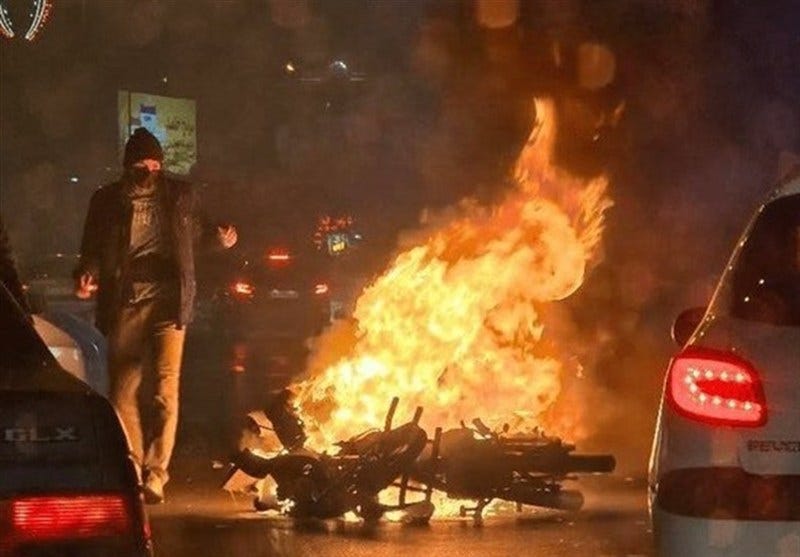
Iran is undergoing one of its most severe internal crackdowns in recent years. The government has imposed a near-total internet blackout, while security forces have reportedly used live ammunition against demonstrators and carried out mass arrests across the country. Due to communications restrictions and limited access for independent observers, casualty figures remain contested, but human-rights organizations and foreign reporting suggest that hundreds may have been killed, with thousands detained. The scale and intensity of repression mark a sharp departure from the authorities’ initial approach.
That shift can be traced to January 8-9, which constituted a clear inflection point in the regime’s handling of the unrest. Prior to that date, the authorities appeared to pursue a strategy of protest management rather than full securitization. Demonstrations were already spreading, yet there was no nationwide internet shutdown, coercive measures remained comparatively localized, and senior officials – particularly within the administration of President Masoud Pezeshkian – publicly acknowledged what they described as legitimate economic grievances, signaling at least rhetorical openness to adjustment.
This posture changed following coordinated nationwide protests on January 8 and 9. The mass mobilization – widely seen as the largest since the 2009 Green Movement – appears to have altered the regime’s threat perception. The decisive factor was not the persistence of unrest, but its scale, synchronization, and visibility, which collectively suggested diminishing confidence in the state’s ability to contain protests through selective pressure.
In response, authorities immediately moved to shut down internet access nationwide and security forces escalated to widespread use of live fire. Official rhetoric hardened in parallel, shifting away from socio-economic language toward an explicitly securitized framing. January 8, therefore, did not merely inaugurate a new protest cycle. It also marked the point at which the state concluded that protest management had failed and that coercive securitization was necessary.
Reframing Unrest: From Protest to “Terrorism” and “Hybrid War”
Following the January 8 inflection point, the state did not merely escalate coercion, but it also redefined the nature of the unrest itself. In official discourse, the category of “protest” largely disappeared, replaced by a composite narrative that framed events as terrorism, separatism, and a foreign-orchestrated campaign of hybrid war. This reframing was neither ad hoc nor confined to a single institution. Rather, it emerged rapidly and coherently across the regime’s political, security, and media apparatus.
At the core of this narrative is the explicit linkage between domestic unrest and the recent 12-day war with Israel. Senior officials and state media have repeatedly presented the protests as a continuation of that conflict “by other means,” rather than as a separate internal crisis. This language was evident in statements following Ali Khamenei’s January 9 speech, which struck a defiant tone and portrayed protesters as actors who “destroy their own country” to satisfy US President Donald Trump. Subsequent statement by the Supreme National Security Council (SNSC) explicitly referenced the 12-day war while warning that security forces were prepared to confront plots allegedly orchestrated by the United States and Israel.
Within this framework, protesters are increasingly described not as civilians but as terrorists. Official rhetoric has shifted to labels such as “rioters,” “destroyers,” and, soon after, to explicit comparisons with ISIS. State-affiliated outlets, particularly Tasnim News Agency, promote claims of armed cells, attacks on civilians, and what they describe as “ISIS-style operations” in Tehran and other cities. Iranian state television has gone further, characterizing the unrest as a “ground invasion,” a formulation that fully aligned domestic demonstrations with wartime threat perceptions.
A third layer of the narrative invokes separatism and civil-war analogies, most notably Syria. Coverage of protests in Kurdish-majority regions in the west and among the Baloch population in the southeast has emphasized alleged ethnic militancy backed by foreign powers. By invoking Syria as a cautionary model, officials suggest that failure to suppress unrest decisively could lead to state collapse and civil war.
Taken together, these discursive shifts underscore that narrative construction has been central, not auxiliary, to repression, providing ideological justification, mobilizing loyalist forces, and situating domestic violence within a broader war paradigm.
Institutional Convergence and Loyalist Mobilization
Despite signs of longer-term elite uncertainty, the immediate response to the protests has been characterized by strong short-term convergence across the Islamic Republic’s key institutions around a war-centric interpretation of unrest. Rather than competing narratives or visible hesitation, the dominant pattern since January 8 has been one of rapid alignment in both language and posture, reinforcing the shift from protest management to coercive repression.
This convergence has been evident across the formal power structure. The Supreme Leader set the tone, which was quickly echoed by the Supreme National Security Council and the intelligence arm of the Islamic Revolutionary Guard Corps (IRGC). Parliamentary leadership followed suit. Mohammad Bagher Ghalibaf, the speaker of parliament, explicitly framed the unrest as part of a multi-front confrontation – economic, cognitive, security, and military – with the United States and Israel, warning that foreign military action would trigger retaliation against Israeli and American targets.
The securitized framing has extended beyond the IRGC. The regular army, i.e., the Islamic Republic of Iran Army, issued a communiqué reaffirming loyalty to the Supreme Leader and describing the unrest as a foreign-backed plot linked to the recent war. Within elite political circles, Ali Larijani, secretary of the SNSC, went further, labeling protesters a “semi-terrorist” group and arguing that Iran remains in a state of war, rendering domestic unrest both illegitimate and dangerous. Clerical figures reinforced this logic. Ayatollah Mohsen Araki, a member of the Assembly of Experts publicly raised the possibility of jihad should the United States or Israel move against Iran or its leadership. Even the “reformist” president Pezeshkian, echoed the same narrative.
This institutional alignment has been paired with active efforts to mobilize core loyalist constituencies, particularly the Basij. State narratives portraying protesters as terrorists and agents of civil war are clearly directed at ideologically committed segments of society, encouraging participation in repression. Electoral data offer a rough sense of this base: in the most recent presidential election, approximately 13 million voters supported the ultra-hardline candidate Saied Jalili, suggesting a sizable pool of regime loyalists that officials appear intent on activating.
The result is a repression effort that is institutionally supported rather than fragmented, at least in the short term, reducing internal constraints on coercion even as broader strategic uncertainties persist.
Deterrence, Preemption, and Narrative Closure
The war framing adopted since January 8 is not merely rhetorical. It serves three interlocking strategic purposes: reinforcing deterrence, facilitating domestic control, and shaping the post-crackdown narrative. Taken together, these functions help explain why references to external conflict and preemption have intensified alongside internal repression.
First, preemption rhetoric has emerged as a logical extension of the war narrative, rather than as an abrupt escalation. Senior officials have repeatedly invoked an earlier statement by the Defense Council, which warned that Tehran would act preemptively if it concluded an attack was imminent. This line was echoed publicly by conservative analyst Saadollah Zare’i, who argued on state television – prior to the mass protests and internet shutdown – that Iran would strike first if it perceived hostile intent. Ghalibaf later reinforced this logic as he repeated the defense council’s statement word for word. Importantly, these statements remain declaratory, consistent with Iran’s established deterrence signaling. Yet their repetition in the context of internal unrest indicates that preemption has become more thinkable as a contingency, even if not imminent.
Second, external escalation rhetoric serves a domestic function. By situating protests within a wartime framework, the leadership seeks to suppress mobilization by signaling that street politics are incompatible with national survival. They also hope that wartime logic could enable rally-around-the-flag dynamics, particularly among ideologically committed constituencies, and lower internal resistance to extreme coercive measures.
Third, the war narrative is instrumental in preparing post-crackdown narrative closure. State-affiliated outlets, especially Tasnim News Agency, have emphasized what they describe as “martyrs” among security forces and framed civilian deaths as the result of ISIS-like terrorist attacks. Iranian state television also actively promotes this narrative. Combined with the internet blackout, this framing is designed to ensure that once protests subside, responsibility for violence can be attributed to “terrorists” rather than state forces.
These dynamics do not make external escalation inevitable. They do, however, compress the regime’s perceived options, expanding the scope of repression at home and increasing the salience of high-risk deterrent signaling abroad.
War Framing as Strategy and Its Limits
The Iranian leadership’s response to the protests reflects a deliberate choice to prioritize war framing over political accommodation. Faced with mass, coordinated mobilization and heightened anxiety about external threats, the state has treated domestic unrest less as a socio-political challenge than as an extension of an ongoing conflict with the United States and Israel. In the short term, this approach may expand the regime’s coercive capacity. By invoking wartime logic, authorities lower internal constraints on repression, mobilize loyalist forces, and justify extraordinary measures that would have been harder to sustain under a protest-management paradigm.
At the same time, it is important to note that this framing is not entirely new. Claims that protests are foreign-instigated, driven by hostile agents, or aimed at destabilizing the state have accompanied nearly every major episode of unrest since at least 2009, and even earlier. What distinguishes the current moment is not the rhetoric itself, but the strategic environment in which it is deployed. Unlike previous protest waves, these narratives are unfolding in the immediate aftermath of a direct military confrontation, amid genuine concern within the leadership about the possibility of further external escalation. Under such conditions, familiar discursive tools acquire materially different consequences.
War framing narrows the regime’s available exit options. It reduces space for de-escalation, increases the political cost of compromise, and renders high-risk scenarios – such as exceptionally broad crackdowns or preemptive external action – more conceivable, even if not imminent. None of this determines outcomes. The current trajectory does not make escalation inevitable, nor does it foreclose the regime’s ability to reassert relative control. But it does compress choices, binding domestic repression and external signaling more tightly together.
As such, the main issue is not whether war framing can serve the regime as a short-term survival strategy, but how the strategic trade-offs it imposes on a system that has chosen coercion under conditions of heightened external risk shape the longer-term trajectory of events.