
How Iran Sees the “Mecca Defense Pact”
What a Trilateral Defense Pact Reveals About the Emerging Postwar Regional Order

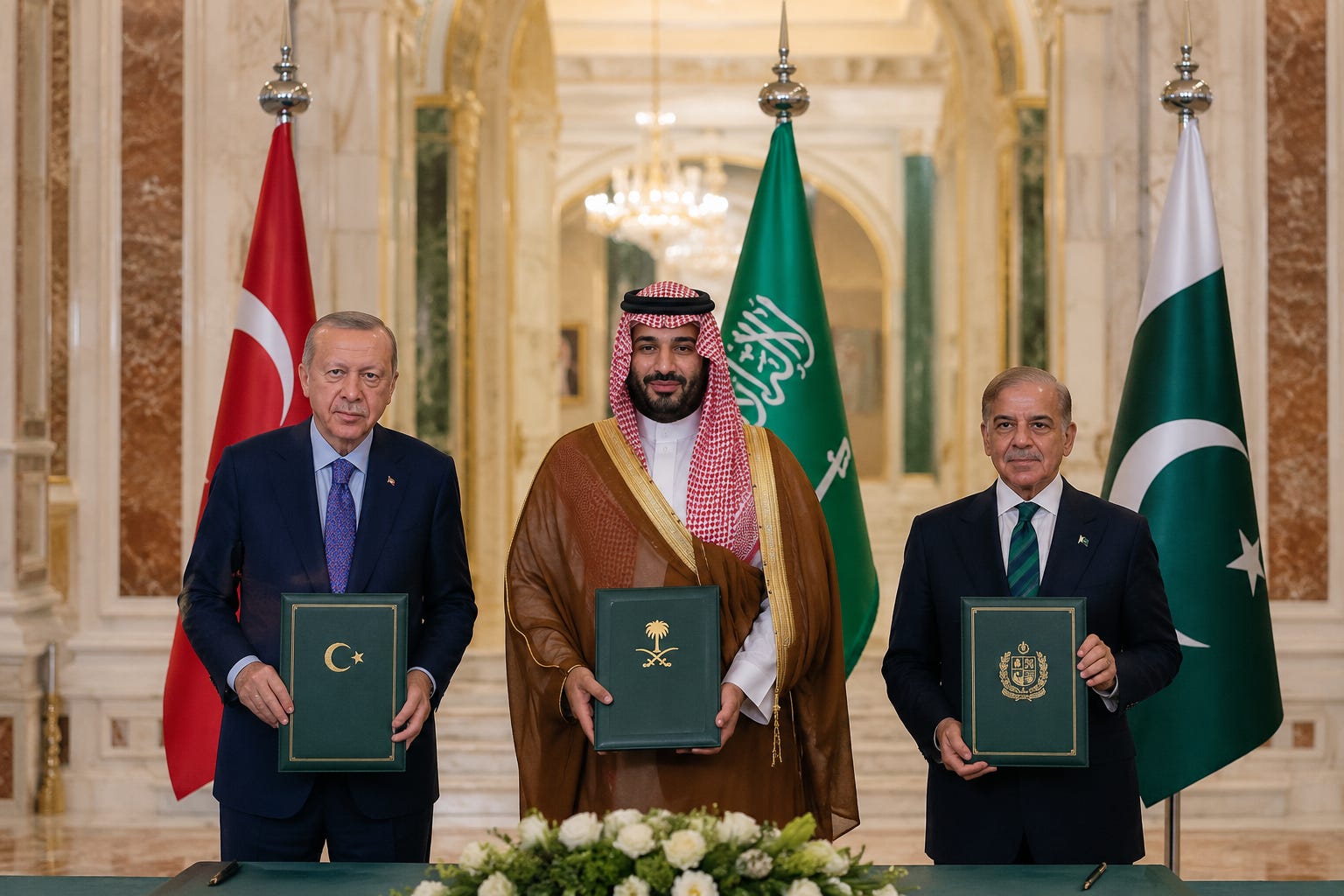
On August 7, the leaders of Saudi Arabia, Turkey, and Pakistan met in Mecca and signed a trilateral joint defense agreement. The signing took place at Al-Safa Palace during a gathering the three governments styled the Makkah al-Mukarramah Summit for Joint Defense, bringing together Saudi Crown Prince Mohammed bin Salman, Turkish President Recep Tayyip Erdogan, and Pakistani Prime Minister Shehbaz Sharif.
The joint statement issued by the three governments is brief but contains a significant mutual-defense commitment. The agreement is intended to strengthen collective deterrence against any act of aggression and stipulates that an armed attack against any one of the three states shall be regarded as an attack against them all. It also provides for strengthening defense cooperation among the three countries. The statement grounds the agreement in longstanding historical ties, bonds of brotherhood and Islamic solidarity, shared strategic interests, and established patterns of defense cooperation.
The three governments were emphatic in presenting the agreement as directed against no one. Turkish Vice President Cevdet Yılmaz said it was not aimed at any specific country, while another Turkish official described it as purely defensive and said it did not alter the signatories’ existing agreements with other states. On the Saudi side, Deputy Minister for Public Diplomacy Rayed Krimly said the agreement constituted neither a military axis nor a sectarian bloc and was not linked to nuclear ambitions or an arms race.
Tehran offered no formal response on the day of the signing. Foreign Minister Abbas Araghchi posted a message calling on Muslim states to stand together and describing the moment as one to rely only on themselves and embrace true brotherhood, though he left unclear whether he was referring to the trilateral agreement. More direct criticism followed. Ebrahim Rezaei, a member of parliament’s national security committee, wrote that a paper agreement with Turkey and Pakistan would bring the Saudis no security, just as years of one-sided dependence on the United States had failed to do, and urged Riyadh to correct its policies so that it would no longer need to seek security from others. Among former officials and analysts, the reaction was more substantive and, in several cases, more concerned.
A Coalition Produced by the War
The most striking feature of the Iranian expert debate is how little disagreement there is about the agreement’s underlying causes. Across ideological lines, Iranian observers read the Mecca agreement as a product of the regional transformation set in motion by October 7 and accelerated by the U.S.-Israeli war on Iran that began in late February. The timing carries much of the meaning. The agreement comes while the war remains formally unresolved, while the Houthis are intensifying their attacks on Saudi interests, while attacks by Iraqi Shia armed groups on Saudi interests have prompted joint U.S.-Saudi strikes on PMF targets in Iraq, and while Iran continues to restrict commercial transit through the Strait of Hormuz. For five months, Saudi Arabia has absorbed missile and drone attacks from multiple directions while its oil exports and development agenda have been placed at risk.
The agreement also grew out of an existing pattern of cooperation. The Saudi-Pakistani strategic mutual defense agreement of September 2025, signed days after the Israeli strike on Doha, established the formula that the Mecca text now extends to Turkey. Through the spring of 2026, the foreign ministers of Saudi Arabia, Turkey, Pakistan, and Egypt met repeatedly in different capitals in an effort to shape a diplomatic exit from the war. What began as diplomatic coordination thus evolved into a security commitment. Egypt was absent from the final agreement, despite months of participation in those consultations, though Turkish Foreign Minister Hakan Fidan has since said that Cairo could join once remaining technical issues are resolved.
Mostafa Najafi, an international relations analyst, traces the agreement to a shift in regional threat perceptions. Developments since October 2023, including Israel’s attempt to establish regional primacy, the recent war, and the emergence of a more assertive Iran, have made Arab states considerably more conscious of their exposure within the existing security order. Saudi Arabia invested for decades in its security partnership with Washington but has concluded that reliance on a single external patron offers limited protection against the consequences of regional conflict. Riyadh’s alignment with Ankara and Islamabad thus forms part of a strategy to diversify its security partnerships and address a balance of threats that increasingly weighs against it with respect to both Iran and Israel.
Saber Gol-Anbari develops the point along a similar axis while placing greater weight on Iran. He argues that over the past three years, the wars in Gaza, Lebanon, and Syria and the pattern of Israeli expansionism had made Israel the principal concern for most regional actors, with the exception of the UAE. Those concerns persist, yet apprehension about Iran has deepened in parallel. He identifies three Saudi objectives. The first is collective deterrence: Riyadh assumes that regional tensions will persist and that the Kingdom could be drawn into a serious confrontation, and it seeks an umbrella that raises Tehran’s costs and shields Saudi infrastructure. The second concerns the construction of a more indigenous regional order, resting on two Saudi conclusions drawn from the war, namely that the Islamic Republic survived the threat of collapse and that American containment of Iran has lost its effectiveness. The third concerns Yemen, where the agreement may function as one layer of a broader Saudi approach designed to shift the local balance while managing Iranian reactions.
Hossein Mahdian, a university professor, arrives at the same conclusion through a more structural lens. He treats the agreement as a first step toward an indigenous regional security architecture less dependent on the United States, emphasizing the complementarity of the capabilities involved: Turkey with one of NATO’s largest armed forces, Saudi Arabia with its financial, energy, and geopolitical weight and strategic location, and Pakistan with its large military and nuclear deterrent. He goes further than most in extending the geography, arguing that the treaty creates the potential for an Anatolia–Arabian Peninsula–Indian subcontinent axis with consequences for the Persian Gulf, the Red Sea, the Arabian Sea, and even the India-Pakistan balance.
Despite their different emphases, these accounts converge on the basic point: the Mecca agreement reflects changed regional circumstances, responds directly to the war, and forms part of a broader effort by regional states to assume greater responsibility for their own security. Iranian analysts broadly agree on this diagnosis. Where they differ is over what the agreement is intended to do.
Encirclement or Architecture?
The central question dividing Iranian analysts is whether this arrangement is aimed at Iran, and if so, how soon and how effectively.
The most alarmed reading comes from commentators closer to the hardline faction, who reject the idea that the three signatories are primarily concerned with Israel. For Saudi Arabia, they argue, Yemen and, by extension, Iran constitute a far more immediate threat than Israel. For Turkey, friction with Israel remains a longer-term and less urgent matter. Pakistan perceives little threat from Israel at all, given its nuclear status, its distance from the theater Israel has defined as its sphere of operations, and Islamabad’s traditional rivalry with India. From this perspective, the agreement is aimed most immediately at Yemen and the Houthis, while also serving as a warning to Iran.
Those advancing this view point instead to developments on the ground. Turkish drones have reportedly been used against the Houthis, while both Ankara and Islamabad have condemned Houthi attacks on Saudi Arabia and aligned themselves with Riyadh. Pakistan has deployed forces to the Kingdom and issued warnings to the Houthis, and some Iranian observers raise the prospect of direct Pakistani involvement, including ground operations in Yemen. They extend the argument to Iraq. Saudi Arabia has already acted alongside the United States against Iran-aligned PMF factions, American pressure on Baghdad to disarm those factions has intensified, and Turkey maintains a substantial presence of its own in the country. Coordinated pressure, or coordinated incentives, directed at the Iraqi government could serve as a counterweight to Iranian influence there.
Geography reinforces that concern. Turkey sits to Iran’s northwest, Saudi Arabia to its southwest, and Pakistan to its southeast. For analysts inclined to this reading, effective implementation of the agreement could deepen Iran’s geopolitical isolation and expose it to pressure from several directions at once. The same commentators have also used the agreement to reopen a domestic debate over Tehran’s reliance on Pakistan as a channel to Washington. They have long argued that Islamabad has vested interests in its cooperation with the United States and functions in practice as an instrument of American regional policy. They now present the Mecca agreement as confirmation of that view.
Mahdian and Najafi push back against this reading without dismissing the significance of the agreement. Mahdian declines to treat the pact as necessarily or exclusively an anti-Iranian coalition, pointing to the divergent positions of the signatories. Pakistan has worked throughout the war to avoid entanglement in the confrontation with Iran while preserving its mediating role. Turkey has a direct interest in preventing the conflict from spreading into Iraq, Syria, the South Caucasus, and the Eastern Mediterranean. Saudi Arabia, having absorbed the pressures of the war, is seeking to diversify its security guarantees. Najafi reaches a compatible conclusion by a different route: the three states entered the agreement with distinct objectives and distinct incentives, sharing one common interest in expanding their strategic options within a rapidly changing environment. For Riyadh the pact adds a layer of security alongside the American partnership; for Ankara it enlarges regional standing and creates balance with respect to Israel; for Islamabad it combines economic returns with security dividends while restoring Pakistan’s position as a consequential power in the Islamic world.
The distinction between these camps is ultimately a distinction between reading the agreement as a coalition and reading it as an architecture. One camp sees a bloc assembling around Iran’s perimeter with identifiable near-term targets. The other sees the early scaffolding of a regional security order whose direction remains unfixed and whose most important consequences may fall outside the Iranian file altogether.
The Distance Between the Clause and the Conduct
Experts like Najafi question how far the agreement’s collective-defense commitment would extend in practice. Would Turkey and Pakistan actually enter a war against Iran if Saudi Arabia were attacked by Tehran?
The answer is skeptical on both counts. Turkey, whatever the depth of its rivalry with Iran, has no interest in a direct, large-scale war with Tehran and prefers to preserve room for maneuver among Iran, Saudi Arabia, Israel, and the United States. Pakistan’s economic and security constraints point the same way. In a scenario where Iran struck Saudi Arabia, the responses of Ankara and Islamabad would most likely “occupy the space between inaction and intervention,” taking the form of political support, intelligence cooperation, logistical assistance, and weapons supply. The significance of the Mecca coalition therefore lies in its symbolic contribution to deterrence rather than in any mechanism for joint entry into war. On this basis Najafi rejects the analogy with NATO. What the three states have created is a balancing coalition, in which each party seeks to widen its own room for maneuver.
This is where the broader framing about regional order becomes relevant. The United States remains the most consequential external power in the region, yet complete reliance on Washington has become too risky for many regional states. Israel has proven unable to impose a new order, and Iran continues to generate strategic pressure. Under these conditions, the Middle East is entering a period of multiple, overlapping, and fluid balancing arrangements rather than fixed blocs, with alignments that are increasingly transactional and responsive to circumstance. The real test arrives when a member faces an actual attack, and the likely avoidance of direct intervention by Turkey and Pakistan would expose the arrangement’s limits without necessarily unraveling it.
Two counterarguments deserve weight against this reassuring conclusion. The first comes from Hesamoddin Ashna, a former official in the Rouhani administration, who argues that the Mecca agreement fundamentally alters the atmosphere surrounding the war. Its most immediate effect would be to reduce the credibility of Iranian threats against the Gulf states, while creating a pathway through which Turkey and Pakistan could be drawn in should Iran threaten Saudi Arabia. Deterrence operates on the calculations of the party being deterred, and the effect Ashna describes requires no combat commitment to materialize.
The second concerns the instruments available below the threshold of war, and it may be the more consequential observation in the entire debate. Some Iranian analysts have noted that the geography of the three signatories opens the possibility of a land dimension alongside the naval blockade already imposed by the United States. Overland routes through Pakistan and Turkey carry significant volumes of Iranian trade, and their importance has grown as the traditional UAE channel became more complicated following the war. Ankara and Islamabad would face no requirement to fight Iran in order to support Riyadh. Restricting Iranian commerce or closing borders would suffice. The asymmetry compounds the problem: Iran’s capacity for military retaliation against Turkey and Pakistan is far more constrained than against the Gulf states, given Turkish membership in NATO and Pakistani nuclear capabilities. Deterrence, in this formulation, works through economic exposure rather than through mutual defense clauses, and it operates exactly where Iran has the least capacity to respond in kind.
The possibility of expanding the coalition raises a related question. Abdollah Ramazanzadeh, a former official in the Khatami administration, has proposed that Iran take the initiative and seek to join the trilateral pact, framing the moment as an opportunity to build a regional arrangement without Israel. The proposal reflects Tehran’s longstanding aspiration for an indigenous regional security order and echoes the language Araghchi used on the day of the signing. But it also runs against the logic that produced the agreement. The coalition took shape as a consequence of the war and, in part, as an effort to contain Iranian power. Expansion remains plausible, and the Gulf states struck over the past five months are the most obvious candidates. Should the arrangement demonstrate genuine deterrent value for Saudi Arabia against Iran or its regional partners, other GCC members may find reasons to join. That prospect is also the strongest argument against Iranian accession.
The Iranian debate, taken as a whole, converges on more than it divides on. Iranian analysts broadly accept that the Mecca agreement registers a real change in regional circumstances, that it emerged from the war and the vulnerabilities the war exposed, and that it belongs to a longer movement toward regionally generated security arrangements. Where they part company is on direction and timeline: whether this constitutes a coalition assembling against Iran with identifiable targets in Yemen, Iraq, and eventually Iran itself, or a structural realignment whose eventual orientation remains genuinely undetermined. Tehran’s official silence, and the studied ambiguity of Araghchi’s appeal to Islamic solidarity, suggest a leadership that has registered the development and has chosen to avoid granting it the recognition that a formal response would confer. The concerns are evident. What remains unresolved is the question the signatories themselves have left open, and the answer will be produced by the next crisis rather than by the text of the agreement.