
All Roads Lead to Muscat
What Iran’s Preference for Oman Reveals About Its Mediation Playbook

In recent days, the diplomatic signaling surrounding renewed engagement between Iran and the United States has been characterized by contradictions and uncertainty. Early reports indicated that a high-level meeting was planned for Friday, with Istanbul initially floated as the venue. These expectations were then thrown into doubt by statements suggesting that the talks had been cancelled, before officials and media outlets moved to reaffirm that the meeting is in fact expected to take place; now in Oman rather than Turkey. Such ambiguity and mixed signaling are not unusual in the context of U.S.-Iran diplomacy. Still, the shift in venue from Istanbul to Muscat points to an important aspect of how Tehran approaches mediated engagement, particularly at moments of heightened tension.
In public commentary, debates over venue are often framed in tactical terms, whether Iran is trying to buy time or influence the other party’s agenda and planning. Such considerations are certainly part of the picture. But focusing on them alone risks overlooking a deeper pattern. For Iran, the choice of mediator and venue has long been tied to how it seeks to structure diplomatic engagement with adversaries. Different settings create different negotiating environments. They affect who is involved, what issues enter the room, and how easily discussions can expand beyond their original mandate. In periods of crisis diplomacy, Tehran has therefore approached mediator selection with particular care, treating it as a strategic decision about how negotiations should be framed and contained rather than simply where they should take place.
This analysis builds on my forthcoming book chapter that examines Iran as a target state of mediation, written as part of an edited volume on middle power mediation by Dalia Ghanem and Dalia Dassa Kaye. The research explores how Iran has responded to different mediation efforts over time – from nuclear diplomacy to the China-mediated rapprochement with Saudi Arabia in 2023 – and identifies recurring patterns in how Tehran evaluates and engages mediators. Rather than focusing solely on the intentions or capabilities of mediating states, it shifts attention to the calculations of the state being mediated, including what it seeks to protect, what it seeks to avoid, and under what conditions it considers mediation acceptable.
Seen through this lens, the move from Turkey to Oman is not primarily about procrastination or symbolism. Instead, it reflects Iran’s effort to keep the agenda narrowly focused, prevent the entry of regional and military files into the talks, and manage both reputational exposure and escalation risks. Venue choice, in this sense, becomes a way to influence who participates, what is discussed, and how far negotiations can expand beyond the initially agreed issues. These considerations have become more acute as military signaling and political pressure have intensified to an unprecedented degree. Understanding why Oman is often acceptable to Tehran, and why other potential mediators, such as Turkey or Qatar, are treated more cautiously, offers a window into how Iran approaches diplomacy when the stakes are high and the margins for error are narrow.
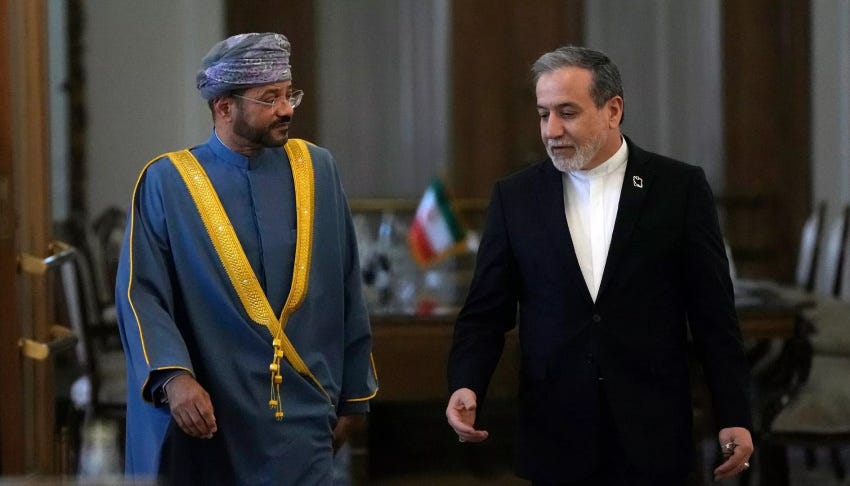
Why Oman Comes First: Iran’s Long View of Mediation
At the most basic level, Iran has consistently distinguished between mediation that facilitates dialogue and understanding and mediation that creates new forms of leverage or aligns with hostile agendas. Oman has been viewed, over time, as falling into the former category. Unlike traditional or emerging regional powers that seek to translate mediation into political influence or regional standing, Muscat has generally confined its role to enabling communication, transmitting messages, and helping parties develop constructive initiatives and explore options without imposing its own agenda. Oman is also seen as a genuinely impartial regional actor that, despite maintaining close relations with the United States, does not represent American interests in any formal capacity, nor does it host permanent CENTCOM bases. These factors have traditionally positioned Oman as a credible mediator in Iran’s view.
A second, closely related factor is discretion. The Islamic Republic’s leadership has repeatedly shown sensitivity to the domestic and regional optics of diplomacy, especially with the United States. Channels that attract attention too quickly, or that create the impression of public bargaining before any concrete understanding has been reached, raise the political cost of engagement. Oman’s mediation style has historically offered Tehran a way to test possibilities quietly while preserving room for maneuver if talks stall or collapse. This is not about secrecy for its own sake, but about reversibility. This is an important consideration for a state that remains deeply skeptical of U.S. intentions and wary of being seen as negotiating from a position of weakness.
Consistency also plays a central role in Iran’s preference for Oman. Over the years, Muscat has remained engaged across different phases of tension and détente, and through changes in leadership in both Tehran and Washington. For Iran, this continuity reduces uncertainty. A mediator that disappears when negotiations become politically difficult, or that sharply reconsiders its position in response to external pressure, presents additional risks. Oman’s value lies partly in the expectation that the channel will survive setbacks, crises, and pauses. Experience has reinforced this expectation.
These characteristics – credibility, discretion, and consistency – intersect with a broader Iranian concern about strategic autonomy. Tehran does not approach mediation as a substitute for direct diplomatic engagement, nor as a pathway to dependency on external actors. Instead, it seeks mediators that allow it to manage vulnerabilities without surrendering control over outcomes. In this sense, Oman’s limited ambitions as a mediator have been an asset rather than a liability. By keeping the scope of its role narrow, Muscat has made itself more acceptable to a state that is highly sensitive to perceived encroachments on sovereignty.
As such, Oman is viewed as a mediator whose incentives are sufficiently aligned with de-escalation and stability, and whose behavior has been predictable enough to make engagement worthwhile.
Why Not Others?
If Oman represents the type of mediation Iran finds most acceptable, the cautious way Tehran approaches other potential intermediaries becomes easier to understand. The Islamic Republic does not reject mediation categorically; rather, it differentiates among mediators based on how their involvement might shape the scope and political meaning of negotiations.
Qatar represents an example of conditional and bounded acceptance. Over the past decade, Doha has played a useful role in facilitating indirect communication between Iran and the United States, particularly on technical, humanitarian, and de-escalatory files. Its partnership with Washington, combined with good working relations with Tehran, has made it an effective conduit for transactional arrangements such as prisoner exchanges, financial transfers, or time-bound understandings. A clear example was the 2023 U.S.-Iran understanding, facilitated by Qatar, that transferred roughly $6 billion in Iranian oil revenues frozen in South Korea into restricted humanitarian accounts in exchange for the release of detained U.S. citizens.
From Iran’s perspective, however, Qatar’s strengths also define its limitations. Because Doha is seen as closely embedded in the U.S. regional security architecture, mediation through Qatar is often viewed as more exposed to American preferences and pressures. As a result, Iran has tended to treat Qatari facilitation as suitable for bounded, issue-specific diplomacy, but less appropriate for comprehensive political or nuclear negotiations where agenda control becomes significantly more important.
Turkey presents a different, though equally constraining, set of considerations. Unlike Qatar, Ankara is not primarily evaluated through the lens of alliance proximity to Washington – though it is, of course, a NATO member. Iran views Turkey mainly as a strategically autonomous regional power with its own ambitions, rivalries, and geopolitical priorities. This does not make Turkey an adversary. Indeed, the two countries maintain functional working relations and cooperate on a range of bilateral and regional issues. However, Turkey’s longer-term ambitions as a regional power create uncertainty from Tehran’s standpoint. Mediation hosted or convened by Turkey therefore risks embedding negotiations within a broader regional diplomatic theater in which Ankara’s own political positioning and agenda-setting impulses could come into play.
The earlier reports that upcoming talks might take place in Istanbul hinted at precisely such considerations. Istanbul was not simply a neutral meeting point. Instead, it carried the prospect of a more public, regionally oriented diplomatic format. For Tehran, this raised familiar concerns of agenda expansion beyond the nuclear file, increased visibility before substantive progress, and the possibility that mediation could evolve into political brokerage. Even if unintended, such dynamics would complicate Tehran’s effort to keep negotiations narrow, controlled, and reversible.
The Deeper Function of Venue
The choice of venue in Iran-U.S. diplomacy may initially appear to be a secondary detail lacking independent significance. In practice, however, it performs a core political function, namely shaping what negotiations can realistically address, who can influence them, and how much room each side has to adjust positions without appearing to retreat. This matters in the current moment because the diplomatic track is unfolding alongside military signaling and heightened regional friction. These conditions make linkage more likely and, for Tehran, more dangerous.
The central risk Iran seeks to manage is that nuclear talks become linked to a broader agenda and evolve into a gateway for wider bargaining over missiles, regional partnerships, or even domestic human rights issues. Once negotiations expand in that direction, the number of stakeholders increases, the list of demands grows, and the probability of breakdown rises. For Tehran, this alters the structure of the game. A narrow negotiation creates space for incremental trade-offs, or steps that can be framed domestically as reversible and proportionate. A broad negotiation, by contrast, invites maximalist expectations, turns the process into a public test of resolve, and empowers external veto players.
In this context, moving talks to Muscat is best understood as an attempt to reduce the number of variables Iran cannot control. A discreet venue lowers the political cost of exploratory engagement and limits the scope for public blame if talks stall. As noted earlier, a mediator with a limited, facilitative posture helps prevent the conversation from becoming a platform for agenda-setting. And a channel with a record of consistency reduces the risk that diplomatic engagement will collapse at the first shock. Taken together, these are viewed in Tehran as practical tools for managing vulnerability under pressure.
This is also why the confusion and contradictory messaging surrounding the talks matter. When negotiations unfold amid uncertainty about timing, format, or even whether they will occur, states have incentives to hedge, probe, and preserve bargaining space. Iran’s emphasis on venue and mediation can be read as part of this broader hedging behavior. In other words, it seeks a setting where engagement does not automatically translate into commitment, and where the process itself does not become an additional burden.
From this perspective, venue politics is not a sideshow to diplomacy. It is, instead, a form of diplomacy.
Process Is Not Outcome
The shift from Istanbul to Muscat highlights how process design can itself become an arena of contestation. Yet agreeing on a venue or a mediator does not, in and of itself, resolve the structural drivers of U.S.-Iran tensions. At best, it creates conditions under which diplomacy can function; it does not guarantee that diplomacy will succeed. The current ambiguity surrounding whether talks will proceed, in what format, and with what scope serves as a reminder that the channel remains fragile and exposed to military incidents and shifting domestic calculations on both sides.
Understanding Iran’s preference for certain mediators, and its caution toward others, is therefore not about legitimizing its diplomatic conduct or endorsing its negotiating posture. It is about explaining the strategic logic through which Tehran seeks to manage pressure, contain risk, and preserve autonomy while engaging an adversary it fundamentally distrusts. Venue politics, in this sense, reflects a defensive diplomatic instinct rather than procedural obstructionism.
Whether Muscat can once again sustain a workable channel remains to be seen. Diplomacy may advance in small steps, stall amid renewed escalation, or collapse under the weight of expanded demands. For now, the risk of confrontation persists alongside the search for de-escalation, and this makes the management of mediation a central feature of the unfolding crisis.